Croatian Utopia

Dialogue Scene: The Croatian Shadow

Setting: A dimly lit underground bunker in a forgotten Croatian coastal fortress. Rain patters outside. Joe Jukic, dressed as Solid Snake — sneaking suit, bandana, tactical gear — leans against a concrete wall marked with old Yugoslav graffiti. Across from him sits Nadya Tolokonnikova of Pussy Riot, colorful punk hair partially tucked under a black beanie, her activist jacket covered in protest patches. A chessboard with scattered pieces sits between them. A holographic projection faintly shows Gary Kasparov mid-speech.
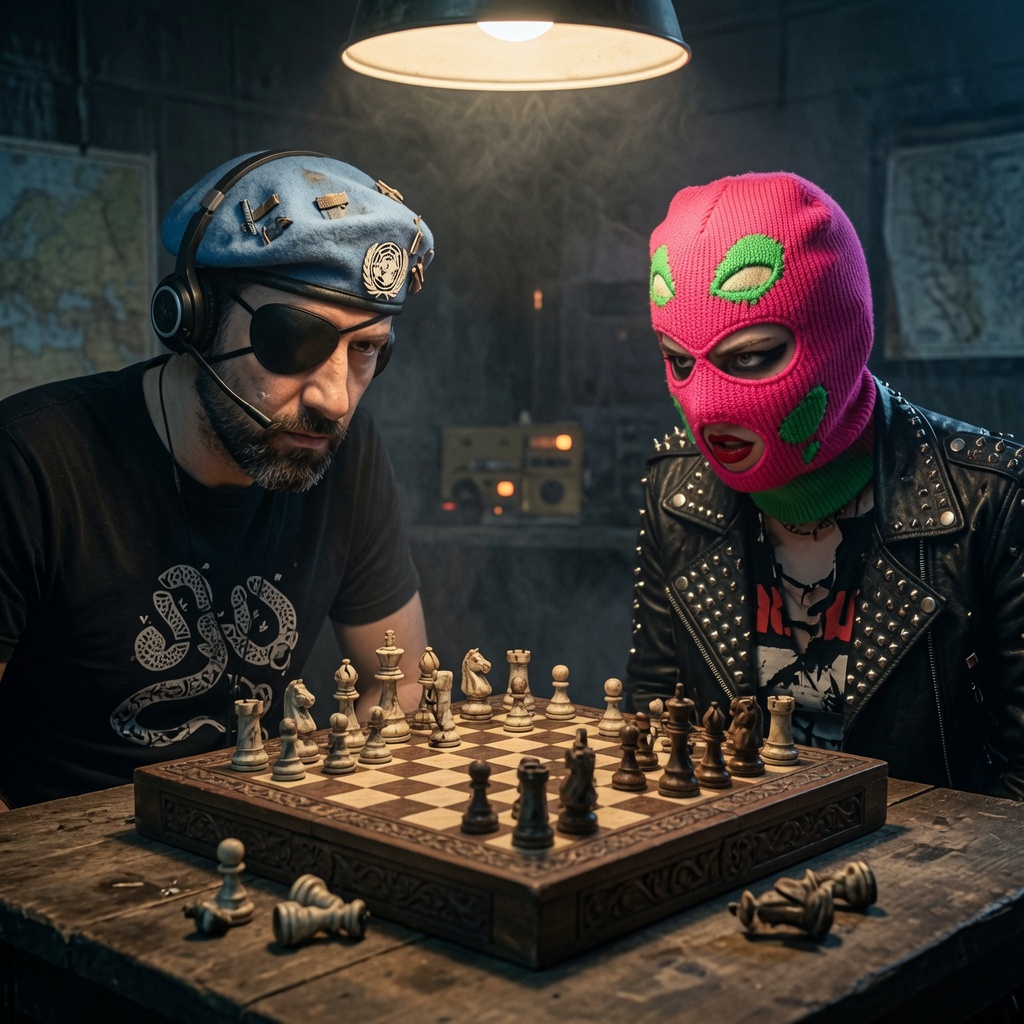

Joe “Solid Snake” Jukic: (voice low, gravelly, with a slight Croatian-Canadian accent) Nadya… you ever wonder why the best minds keep running? Kasparov saw the writing on the wall years ago. Grandmaster of the board, but he knew the real game was rigged. He fled Russia, left it all behind. Landed in a Croatian Utopia — olive groves, clean sea air, people who still remember what freedom tastes like before the machine took over. No more oligarch shadows. No more silencing the voice.

Nadya: (leaning forward, eyes sharp, with a sarcastic smirk) Kasparov? The chess king who finally checked out? I respect the exit strategy. But Utopia? In Croatia? Sounds like another pretty cage, Joe. Or are you selling me the same dream you sold yourself when you chose Canada over the old country? Pussy Riot doesn’t do exile tourism. We smash the system from inside the cage.

Joe “Solid Snake” Jukic: (chuckles darkly, adjusting his bandana) Not tourism. Survival. I sacrificed everything — wife, kids, the old life — just to keep one more song alive in a place that could still work. Croatia’s got the bones of something real. Interest-free loans. Debt jubilee. Maglev trains cutting through the hills instead of tanks. The door’s still open for you, Nadya. You, your crew, the ones who actually fight. Come build it with us. East Van to the Adriatic. No more running from Agent Smiths and snakes in suits. We flip the board.

Nadya: (pauses, staring at the chess pieces, then at Joe) …The door, huh? Kasparov made his move. Maybe it’s time for a different kind of riot. Tell me more about this “Utopia,” Solid Snake. But if it’s just another pyramid scheme with better views, I’ll burn it down myself.

Joe “Solid Snake” Jukic: (small smile, extending a hand) Deal. First round’s on Croatian wine and honest talk. The people decide — not the elites. Welcome to the referendum, comrade.


Fade out on the two of them shaking hands as the projection of Kasparov nods approvingly in the background.
What do you think of this post?
  • Awesome (0)
  • Interesting (0)
  • Useful (0)
  • Boring (0)
  • Sucks (0)

Belgians In the Congo

King Leopold II of Belgium ruled the Congo Free State from 1885 to 1908, and his reign is marked by extreme brutality and exploitation. Here’s a detailed overview of his involvement in the Congo:

Acquisition of the Congo

  • Berlin Conference (1884-1885): King Leopold II secured international recognition of his personal control over the Congo during this conference, which regulated European colonization and trade in Africa.
  • Congo Free State: Unlike other colonies, the Congo was not a Belgian state colony but rather Leopold’s private property.

Exploitation and Brutality

  • Rubber and Ivory: The main economic activities involved the extraction of rubber and ivory. The demand for rubber, driven by the invention of the pneumatic tire, led to severe exploitation.
  • Forced Labor: The Congolese were forced into labor to harvest rubber and gather ivory. Failure to meet quotas often resulted in brutal punishment.
  • Atrocities: Widespread atrocities were committed, including mutilation, killings, and taking hostages. Reports documented that hands were cut off as proof that bullets had not been wasted, a method used to enforce terror and compliance.
  • Population Decline: It is estimated that the population of the Congo decreased by millions during Leopold’s rule due to the harsh conditions, violence, and diseases exacerbated by exploitation.

International Outcry and Reform

  • Casement Report (1904): British consul Roger Casement’s report on the abuses in the Congo brought international attention to the human rights violations.
  • E.D. Morel: A British journalist and activist, Morel campaigned against the atrocities, founding the Congo Reform Association.
  • Literary Works: Writers like Joseph Conrad (“Heart of Darkness”) and Mark Twain (“King Leopold’s Soliloquy”) criticized the exploitation and helped raise awareness.

Transfer to Belgium

  • Annexation (1908): Due to international pressure and domestic outcry in Belgium, the Belgian government took control of the Congo from Leopold, renaming it the Belgian Congo. This transfer marked the end of Leopold’s personal rule but did not immediately end the exploitation and mistreatment of the Congolese people.

Legacy

  • Long-term Impact: The exploitation and brutal practices under Leopold’s rule had long-lasting effects on the Congo’s social, economic, and political structures.
  • Modern Perspectives: Today, Leopold II’s legacy is widely condemned, and his rule is often cited as one of the most egregious examples of colonial exploitation and human rights abuses.

King Leopold II’s rule over the Congo Free State remains a stark reminder of the devastating impacts of colonialism and the lengths to which individuals and nations went for economic gain at the expense of human lives and dignity.

What do you think of this post?
  • Interesting (1)
  • Awesome (0)
  • Useful (0)
  • Boring (0)
  • Sucks (0)

I Was Here

I won’t take the mark

the verichip, because i was here

What do you think of this post?
  • Awesome (0)
  • Interesting (0)
  • Useful (0)
  • Boring (0)
  • Sucks (0)