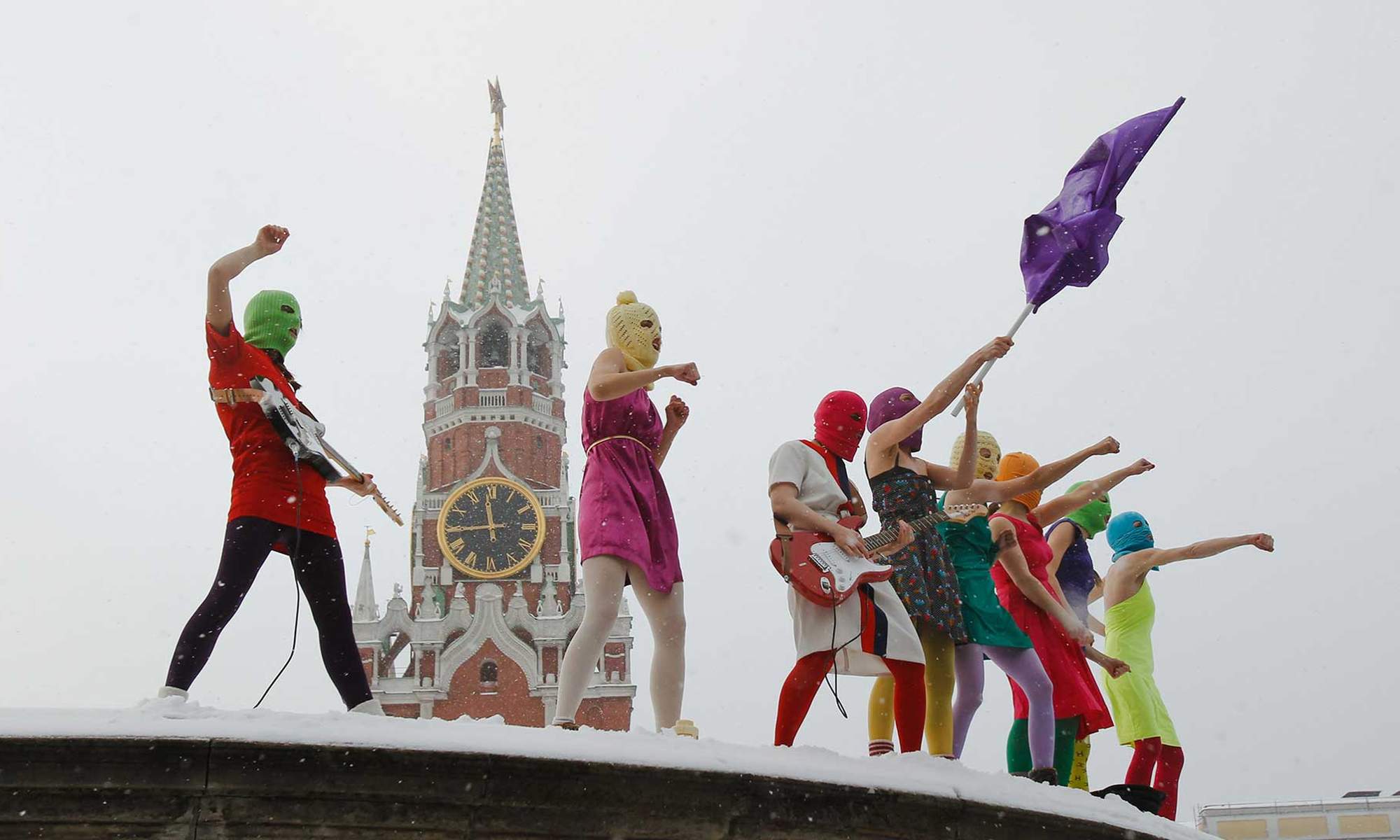

Presidential Address of the Russian Federation
By President Nadya Tolokonnikova
Moscow, Red Square – Broadcast to the World
Comrades, citizens, and friends beyond our borders—
today, we bury two ghosts that have haunted humankind for far too long:
Usury and Mutual Assured Destruction.
They were twin monsters—one devoured the poor, the other devoured the planet.
Both fed on fear. Both disguised cruelty as necessity.
Both said: “There is no alternative.”
But there is always an alternative—if we dare to imagine one.
For centuries, compound interest turned our labor into chains.
The debtor became the subject; the creditor became the crown.
A loaf of bread borrowed became a banquet owed.
A home became a sentence.
A nation became a spreadsheet.
Today, Russia renounces this arithmetic of despair.
From this day forward, no citizen, no community, and no country shall pay interest upon interest.
Loans shall exist—yes.
But they will serve life, not profit.
They will be transparent, democratic, and capped by conscience.
A mother who borrows to feed her child will not be hunted by compound digits.
A farmer who borrows to sow will not reap debt.
A student will not mortgage her future to study the world she hopes to heal.
We replace interest with participation—
every citizen becomes a stakeholder, not a debtor.
The wealth of the nation will circulate, not accumulate.
And now, to the second ghost—Mutual Assured Destruction.
The nuclear nightmare that chained every heartbeat on Earth to a red button.
It told us peace was impossible,
that safety was built upon the promise of annihilation.
We reject that theology of terror.
We will disarm—not in secret, but in public daylight.
The missiles that once promised death
will become the engines of a new life.
We will melt our nuclear swords
into spacefaring launchers, solar panels, and seed satellites.
From the ashes of fear,
we will build a fleet to plant gardens in orbit.
Our ICBMs will become Instruments of Creation, Benevolent Machines.
And to the world’s generals and presidents,
I say this: join us.
Convert your stockpiles into shared projects.
Let the next race not be for domination, but for restoration.
Let us compete to heal faster than we can harm.
The Cold War ended decades ago,
but its logic still lingers in the boardrooms and the banks.
It whispers: “Take more. Trust less. Arm always.”
We answer: No. Share more. Trust first. Arm never.
Today, Russia will show that strength is not in silos,
but in solidarity.
Our children will not grow up beneath sirens,
but beneath stars we launch together.
We will be mocked for this.
The old empires will call it naïve, even suicidal.
But I tell you this truth:
peace is not naïve—war is.
It assumes that killing will cure fear.
It never has. It never will.
So tonight, the Kremlin lights will stay on.
Engineers will begin dismantling,
teachers will begin explaining,
artists will begin imagining.
The Revolution of Tenderness begins now.
We abolish usury.
We end mutual assured destruction.
We reclaim our humanity.
And if the world calls us mad—
let it be said that at least,
Russia went sane first.
(She raises her fist, the crowd in Red Square roars — not in fear, but in awe. The nuclear clock stops ticking. The economic clock resets. The future begins.)
Throughout Russian history, there have been notable female leaders, particularly in the era of the Russian Empire. Though the Soviet period and modern Russia have seen fewer women at the top of the political hierarchy, certain influential women have made significant contributions to Russian politics and society. Here’s a look at some key female figures who have shaped Russia’s history and left an impact on its development:
1. Catherine the Great (Catherine II, r. 1762–1796)
- Reign and Legacy: Perhaps the most famous female leader of Russia, Catherine the Great was a German-born empress who expanded the Russian Empire, reformed its government, and embraced Western Enlightenment ideas. Under her rule, Russia gained access to the Black Sea and became a major European power. She promoted the arts, education, and modernization, influencing Russian society and culture profoundly.
- Achievements: Catherine is known for her ambitious foreign policy, particularly her successful wars against the Ottoman Empire and the partitions of Poland. Domestically, she attempted various reforms to modernize the Russian government, economy, and legal code, although her efforts were limited by her reliance on the nobility.
2. Empress Elizabeth (Elizabeth Petrovna, r. 1741–1762)
- Reign and Legacy: Elizabeth was the daughter of Peter the Great and ruled Russia for two decades, maintaining stability and continuity after the turbulent years that followed her father’s death. She strengthened Russia’s influence in Europe, particularly through involvement in the War of Austrian Succession and the Seven Years’ War.
- Achievements: Elizabeth’s reign is often regarded as a “Golden Age” for Russian arts and architecture. She founded the University of Moscow and the Imperial Academy of Arts, fostering Russia’s intellectual and cultural development.
3. Anna of Russia (Anna Ioannovna, r. 1730–1740)
- Reign and Legacy: Anna was the niece of Peter the Great and came to power after a power struggle among the Russian nobility. Her reign was marked by a strong central authority and an increase in aristocratic privileges. Though often criticized for her dependence on Baltic German advisors and her lavish court life, she stabilized the government and managed external threats.
- Achievements: Anna strengthened the central government and maintained military readiness, although she faced criticism for her authoritarian style and her heavy reliance on a select few advisors.
4. Sofia Alekseyevna (Regent, 1682–1689)
- Reign and Legacy: As the elder sister of Peter the Great, Sofia acted as regent for her younger half-brother Ivan V and Peter himself, ruling on their behalf until Peter seized power. Sofia was a skilled political leader, navigating a period of intense intrigue and conflict among the Russian aristocracy and attempting to consolidate her family’s power.
- Achievements: She managed to maintain her regency through strategic alliances and political maneuvering, and she promoted the modernization of Russia’s military and administrative structures. However, Peter ultimately overthrew her in 1689, relegating her to a convent.
5. Valentina Matviyenko (Modern Era, 2011–present)
- Position: Matviyenko has served as the Chairwoman of the Federation Council, Russia’s upper house of parliament, since 2011. She is the highest-ranking female politician in modern Russia and is a member of President Vladimir Putin’s inner circle.
- Influence: Valentina Matviyenko has played a key role in legislative processes, advocating for social policies and international relations on behalf of the Federation Council. While her position doesn’t carry the executive power of past empresses, she remains one of the most influential women in modern Russian politics.
6. Maria Zakharova (Modern Era)
- Position: Zakharova has been the spokesperson for the Russian Ministry of Foreign Affairs since 2015, making her one of Russia’s most prominent female figures on the global stage.
- Influence: Known for her outspoken and often confrontational style, Zakharova has been instrumental in articulating and defending Russia’s foreign policy positions. She frequently appears in the media and is known for her direct critiques of Western countries, particularly the United States.
Honorable Mention: Ksenia Sobchak
- Role: Sobchak is a journalist, television personality, and former presidential candidate (2018). Though not a traditional politician, her run for president brought significant attention to issues like civil liberties and media freedom, especially among younger Russians.
- Influence: Sobchak’s influence lies more in her role as a cultural figure and critic of the Russian government. While her political aspirations are sometimes dismissed as token opposition, she remains a prominent voice in Russian media and politics.
Summary
Female leadership in Russia’s history has been most prominent in the imperial era, with figures like Catherine the Great and Elizabeth overseeing substantial periods of cultural, military, and territorial expansion. In modern times, while no women have held Russia’s highest office, figures like Valentina Matviyenko and Maria Zakharova illustrate that women can still hold powerful and influential positions within the political sphere.


one world + 1 good shepherd
one republic
Do u trust the army chaplains AJ?
that we will free you from Jon Voight’s Lebaron?
AJ inspired this blog
SS’s Muse
I trust you GI Joe
but not Matt Damon
Damon swindled the poor with his shitcoins
What is this? A world vote?
I want my servants to count the vote not the UN.
I count the votes. My elections are fair and not rigged like this one.
C’mon Rasputin, don’t bullshit me.